
Braided Hose Types: Rubber, PTFE and Stainless Steel
Updated · 6 min read
Start with the inner tube, not the shiny outer braid. Compare three constructions supplied by RHPL and find the right product page for your enquiry.
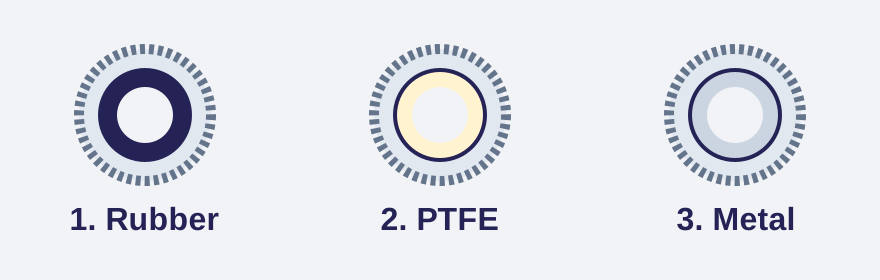
What Does Braided Hose Mean?
A braided hose has interwoven reinforcement around its inner tube. The braid helps the hose carry its intended load while allowing a designed degree of movement. It does not tell you what touches the fluid. That inner layer may be rubber, PTFE or corrugated stainless steel, and this difference matters more than a similar-looking outside.
For maintenance and purchase teams, “braided hose” is therefore a starting description, not a complete specification. An enquiry for “SS braided hose pipe” may mean a PTFE-lined hose with a stainless braid or an all-metal corrugated hose with an outer braid. Ask which construction is required before comparing offers. RHPL supplies the three families below; use this chooser to reach the relevant product page.
Identify the Three Constructions
These simplified cutaways show the layers, not a specific RHPL product. The braid is peeled back for identification; do not cut or strip an installed hose to identify it. Check the hose marking, drawing or supplier record.
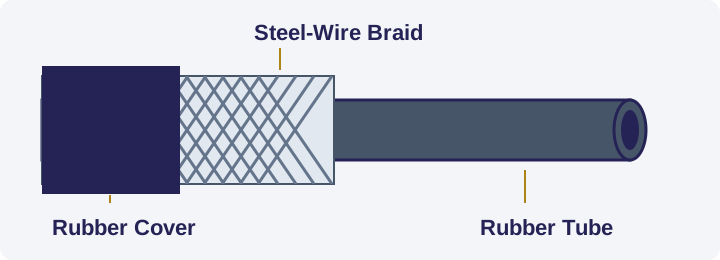
Wire-Braided Hydraulic Rubber Hose
This construction combines a fluid-compatible rubber tube, steel-wire reinforcement and a protective rubber cover. Common buying descriptions include one-wire SAE 100R1AT and two-wire SAE 100R2AT, alongside EN 853 1SN and 2SN families. Confirm the exact standard and product marking; similar designations do not establish automatic interchangeability.
It is a usual starting point for hydraulic oil lines on machinery, subject to the circuit requirement. The braid normally sits beneath the cover, so an intact hose may look entirely black. Wire count alone cannot select a replacement: the fluid, movement, coupling system and manufacturer's data must also match. Continue to hydraulic hoses for supply options.
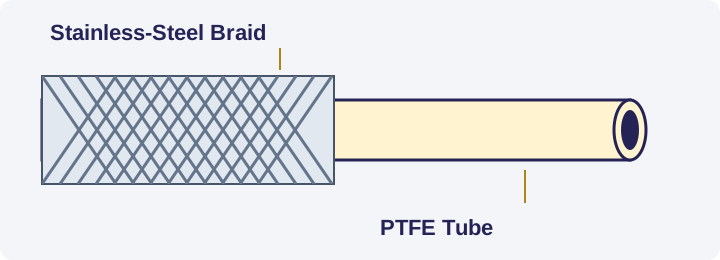
PTFE-Lined Hose With Stainless Braid
Here the conveyed medium contacts PTFE, a fluoropolymer, while the stainless braid provides reinforcement. The visible metal weave does not make the fluid path all-metal. PTFE constructions are considered for compatible chemical and process duties, including applications requiring temperature resistance beyond that of some rubber constructions.
Suitability still depends on the particular hose and complete assembly. Smooth-bore and convoluted designs behave differently when bent. Chemical compatibility, permeation and any static-dissipation requirement need review for the actual medium. Use the PTFE hose assemblies page to discuss the required lining and connections.
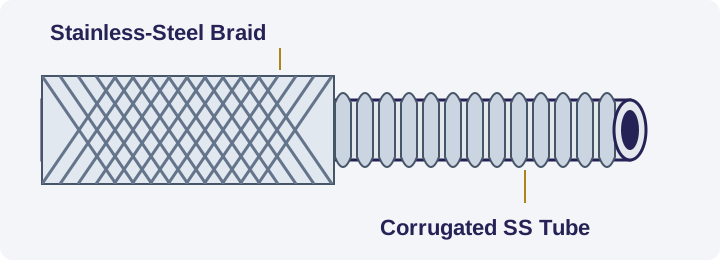
Corrugated Stainless-Steel Hose With SS Braid
In this family, a corrugated metal tube forms the fluid path. Its formed convolutions permit controlled bending; the outer braid restrains pressure-induced extension. It is a candidate for suitable plant piping connections, thermal movement and selected vibration duties where a metal fluid path is required.
Alloy compatibility and movement conditions are essential. A hose that bends during installation is not automatically suitable for repeated flexing. Temperature changes the allowable working conditions, and twisting must be avoided. Continue to SS corrugated hose assemblies for application review.
Compare the Families Before Choosing a Product
The table gives general selection cues, not approval for a medium or an assembly rating. Each candidate needs its own current catalogue and operating-condition check.
| Construction | Typical Media to Evaluate | Temperature and Flexibility Notes | Typical Uses | RHPL Page |
|---|---|---|---|---|
| Rubber Tube + Wire Braid + Cover | Hydraulic oils; other fluids only where the selected rubber compound is approved. | Check fluid and ambient heat. Follow the specified bend radius through machine movement. | Machine hydraulic circuits and equipment replacement lines. | Hydraulic Hoses |
| PTFE Tube + SS Braid | Compatible chemicals and process fluids. | Temperature capability is design-specific; bore form affects bending. Review permeation and static requirements. | Selected chemical transfer and process connections. | PTFE Assemblies |
| Corrugated SS Tube + SS Braid | Compatible liquids, gases or steam after alloy and duty review. | Check temperature derating, static versus repeated movement and torsion-free routing. | Plant piping connections and engineered movement accommodation. | SS Corrugated Assemblies |
How to Choose: A Purchase and Maintenance Checklist
- Identify the fluid path. Read the old marking or drawing and establish whether the tube is rubber, PTFE or metal. A photograph of the outer braid alone is insufficient.
- Name the medium precisely. Include the fluid grade or chemical name, concentration and cleaning media. Check compatibility of the tube, end fittings and seals together.
- Record the operating conditions. Provide normal and peak pressure, any vacuum, fluid temperature and surrounding heat. Include start-up and cleaning conditions rather than only normal running duty.
- Describe movement and routing. Separate a fixed installed bend from repeated travel, vibration or thermal movement. Supply a route sketch showing clamps and nearby surfaces, with enough room for the selected bend radius.
- Confirm the complete assembly. Identify bore, overall length, end connections, sealing faces and orientation. Matching the machine-end thread does not prove the fitting suits the hose-retention system.
- Make approval traceable. Ask for the proposed product identification and applicable assembly information. Have the responsible maintenance or engineering team approve any change of construction before purchasing.
If the requirement is already a hydraulic replacement assembly, go directly to hydraulic hose assemblies. If the construction is uncertain, send the available evidence through Request a Quote and flag the unknowns. Include quantity, equipment or plant duty and delivery destination so the enquiry can be reviewed without guessing.
Frequently Asked Questions
Is Every SS Braided Hose an All-Metal Hose?
No. Stainless braid can surround a PTFE tube or a corrugated stainless-steel tube. The liner or inner-tube description identifies the fluid path; the outer weave alone cannot distinguish them.
Is Two-Wire Hydraulic Hose Always the Better Choice?
No. The selected hose must meet the circuit and routing requirements. A different construction may alter outside diameter, bending behaviour and coupling compatibility. Confirm the exact product rather than choosing only by wire count.
Can PTFE Braided Hose Replace Rubber Hydraulic Hose Directly?
Not from appearance or thread size alone. Review the fluid, operating conditions, movement and approved hose-and-fitting combination before considering a change. Keep the equipment requirement as the starting point.
Can Any Braided Hose Be Used for Steam or Chemicals?
No. The exact medium, temperature, pressure and complete assembly require review. A stainless braid does not establish chemical compatibility, steam suitability or a universal temperature limit.
What Should I Send for an SS Braided Hose Pipe Enquiry?
Send the inner-tube description if known, readable markings, end photographs, dimensions and operating details. State whether the hose is fixed or moving. If the liner is unknown, say so and request identification before accepting an alternative.
Technical References
Consult the current product and equipment instructions for the proposed application. The references below support the general technical background; they do not validate an RHPL assembly.
- Gates — Hydraulic Hose Products 2025 Catalogue (G1 and G2 Construction)
- Parker — Catalogue 4460-UK, PTFE Hoses (919, 929/929B and 939/939B)
- Hose Master — Corrugated Metal Hose and Assemblies Catalogue
- Hose Master — Selecting a Metal Hose: Three Variables to Consider
- Hose Master — Select the Right Hose (Application Checklist)
Caterpillar, Volvo, Komatsu, Hitachi, Danfoss, Parker, Manuli and Swagelok are trademarks of their respective owners. RHPL is not affiliated with or endorsed by these brand owners. Gates is a trademark of Gates Corporation; RHPL is an Authorised Gates Distributor. Brand and machine names are used only to identify compatibility. External manufacturer references provide general technical background and do not imply endorsement of RHPL products.