
RHPL-OR-0001
Equipment cross-reference: 4J-5267
Also searched as 4J5267
- Inside diameter
- 24.99 mm
- Cross-section
- 3.53 mm
- Reference material
- NBR / Nitrile · 90 Shore A
- Dash size
- 214
Identify the seal by its reference, dimensions and operating duty. O-ring enquiries for mining, construction, HEMM, hydraulic systems and industrial maintenance.
OEM reference data, checked 23 September 2026. Actual supplied specification and availability are confirmed in the quotation.
Equipment cross-reference: 4J-5267
Also searched as 4J5267
Equipment cross-reference: 4J-0520
Also searched as 4J0520
Equipment cross-reference: 4J-0522
Also searched as 4J0522
Equipment cross-reference: 4J-0524
Also searched as 4J0524
Equipment cross-reference: 4J-0527
Also searched as 4J0527
An O-ring is a circular-section elastomer seal compressed in a defined housing. It seals static joints and selected dynamic applications; motion, friction and lubrication must be assessed for moving seals. A part number identifies a reference, not every service condition.
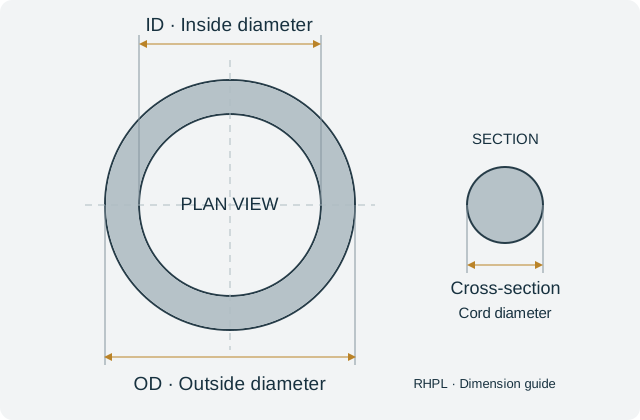
Inside diameter (ID) measures the opening. Cross-section, also called cord diameter, measures the circular section. Outside diameter (OD) relates geometrically to ID plus twice the cross-section. A dash size is a size designation, not a pressure rating. Confirm dimensional tolerances and the required standard.
Groove or gland geometry controls squeeze, available space and support. Stretch changes the installed cross-section. Too little compression can leak; excessive compression or stretch can damage the seal. Check the gland drawing rather than selecting on a worn seal alone.
Pressure, clearance, temperature and compound properties act together. Extrusion occurs when the seal is forced into a clearance gap. Backup rings can support a seal where the gland design requires them; their position depends on pressure direction and the approved design. Hardness alone is not a pressure rating.
NBR (nitrile), HNBR, FKM, EPDM, silicone and specialised elastomers are distinct families. A family name does not specify the compound, cure, hardness or approvals. RHPL does not represent every family as stocked. Request the actual supplier compound datasheet for the proposed item.
Share the fluid name, concentration, additives, cleaning media, and both operating and ambient temperatures. Compatibility and temperature limits must be checked for the exact compound. No general family-level range here is a supplied-product guarantee.
Inspect the gland and sealing surfaces for burrs, scratches and contamination. Use the equipment maker’s installation procedure, suitable tools and approved lubricant. Avoid dragging seals over exposed threads, excessive stretching and twisting. Keep the new seal identified until installation.
Compression set reduces recovery after compression; swelling changes size following fluid exposure. Abrasion may follow relative motion or rough surfaces. Extrusion can nibble the edges, while twisting and installation cuts leave different damage. Keep the failed seal and operating history for investigation instead of assuming a harder material will solve the problem.
Retain supplier packaging and batch identification. Keep seals clean, unstressed and protected from damaging storage conditions; follow supplier shelf-life and storage guidance. Do not mix similar sizes or identify an elastomer by colour alone.
ISO 3601-1 addresses dimensions, tolerances and designation; ISO 3601-2 covers housings; ISO 3601-3 covers quality acceptance; ISO 3601-5 addresses elastomer material specifications. SAE AS568 provides standard size references and dash numbers. A standards reference is not a claim that an offered item is certified.
The listed reference records contain verified OEM reference data. RHPL confirms the offered manufacturer, compound, dimensions, hardness, quantity and application before supply. The quotation establishes the supplied item; reference data is not evidence of genuine-OEM provenance.
General selection references do not certify the items offered by RHPL. Each part page links its OEM reference source.
RHPL is an independent manufacturer and supplier. OEM names and part numbers are used for identification and cross-reference purposes only. Product compatibility is subject to technical confirmation. Third-party trademarks remain the property of their respective owners.
One part, a complete kit or a list from Excel—all in one enquiry.