
PTFE (Teflon) Hose Assemblies
RHPL supplies PTFE hose assemblies cut to length with matched end fittings for chemical transfer, process equipment and selected hot-fluid duties. Send the service conditions so we can confirm the liner, braid and complete assembly specification.
What Is PTFE Hose?
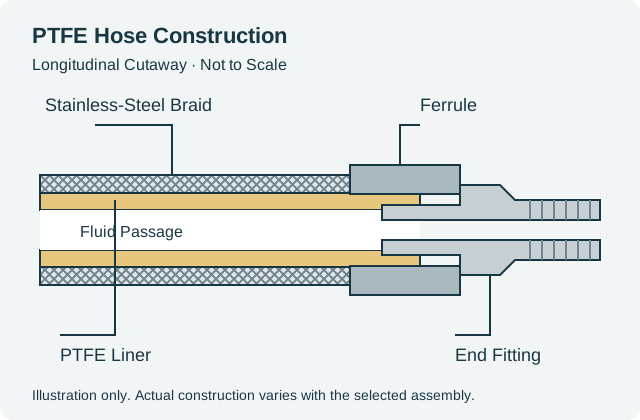
PTFE is polytetrafluoroethylene, a fluoropolymer used as the fluid-contact liner. Buyers often call it Teflon hose or Teflon hose pipe. Teflon is a trademark; that common search term does not identify the brand of material supplied by RHPL. In a PTFE braided hose, stainless-steel wire braid surrounds the liner to provide reinforcement. The liner, braid and matched end fittings work together as an assembly.
The shiny exterior alone does not identify the hose. A stainless-steel corrugated hose has a metal fluid-contact tube; a PTFE-lined hose has a polymer tube inside its braid. Share a drawing or the existing hose marking when replacing one.
Smooth-Bore PTFE Liner
A smooth internal passage supports fluid flow and cleaning with fewer recesses for material to collect. It is often considered for transfer lines where drainage and product changeover matter. Confirm the required flexibility and routing space for the exact hose construction.
Convoluted PTFE Liner
A convoluted liner has a formed profile that allows greater flexibility in suitable constructions. Selection depends on movement, available space, flow requirements and cleaning needs. The word “convoluted” alone does not establish a permitted bend radius or a pressure rating.
Chemical Resistance and Cleanability
PTFE is chosen for its broad chemical resistance and non-stick surface, which can help reduce deposits. Compatibility still needs review for the actual medium, concentration and temperature, including all wetted fitting and seal materials. Share the cleaning fluid as well as the production fluid.
Heat, Steam and Permeation
Suitable PTFE constructions can serve high-temperature and steam duties. Temperature affects the allowable working pressure of the selected assembly. Low permeation is another selection benefit of appropriate liner constructions, but PTFE is not a zero-permeation barrier: review the fluid or gas, liner design and operating conditions.
Where PTFE Hose Is Used
- Chemical and process plants: transfer and equipment connections selected for the process medium.
- Steam lines: only with a construction accepted for the steam condition, cycling and cleaning duty.
- Paint and solvent transfer: assess static generation and whether a conductive liner and grounding arrangement are required.
- Hydraulic and lube lines near heat: check fluid temperature, external heat exposure, pressure peaks and routing together.
- Food and pharmaceutical service: where the specific hose, fittings and documentation meet the buyer’s hygiene and compliance requirements. PTFE material alone does not make every assembly food or pharma approved.
How RHPL Builds the Assembly
RHPL prepares the selected hose to the agreed length and assembles matched end fittings using the applicable crimping or swaging system. BSP, JIC, NPT and flange ends can be discussed against the required size, sealing interface and duty. The hose and fitting combination, attachment method and end orientation are confirmed before manufacture.
Inspection and pressure testing follow the agreed assembly specification and acceptance criteria. Identify any test certificate, witnessing or traceability requirement at quotation stage. A test does not establish an operating rating beyond the selected components’ documented limits. See our hose assembly services and hose fittings and connection options.
What to Send for an RFQ
- Hose inside diameter (ID), quantity and preferred liner construction, if known.
- Overall assembly length, measurement points and a drawing or sample reference.
- End A and End B: thread or flange standard, size, male/female, sealing face, material and orientation.
- Media name and concentration, including cleaning fluids and any gas or vacuum service.
- Normal and maximum fluid temperature, ambient heat and cleaning or steam cycles.
- Working pressure, pressure peaks, movement, routing restrictions and inspection documents.
For repeat supply, include the earlier quotation or hose identification and explain any change in duty.
Frequently Asked Questions
Are PTFE Hose and Teflon Hose the Same?
“Teflon hose” is commonly used for PTFE-lined hose. Specify PTFE and the required construction in your enquiry; the quotation identifies the actual offered product.
Does Stainless-Steel Braid Make the Liner Metallic?
No. The outer braid reinforces the hose. PTFE remains the fluid-contact liner, while the fitting bore or seals may expose other materials to the medium.
Can Any PTFE Hose Be Used for Steam or Solvents?
No. Send the full duty for selection, including steam cycling or solvent concentration and flow conditions. Static-dissipation needs and the suitability of the complete assembly require review.
What Pressure and Temperature Can RHPL Supply?
The written offer confirms the limits for the selected hose size, construction and fittings. A generic PTFE material description cannot establish the assembly’s working pressure, temperature limit or bend radius.
Can I Order a Custom Length with Different Ends?
Yes, send the required overall length and both connection details. RHPL reviews the proposed hose and end-fitting combination before confirming the assembly.
Last updated: