4SP vs 4SH Hydraulic Hose: Pressure, Bend Radius and Selection
Updated · 7 min read
A hose marked 4SP is not automatically interchangeable with one marked 4SH. Both belong to the spiral hydraulic hose family, but the correct replacement depends on the exact product, bore, circuit duty and approved hose-and-coupling combination. This guide helps maintenance and purchase teams compare enquiries before ordering.
What Are 4SP and 4SH Hoses?
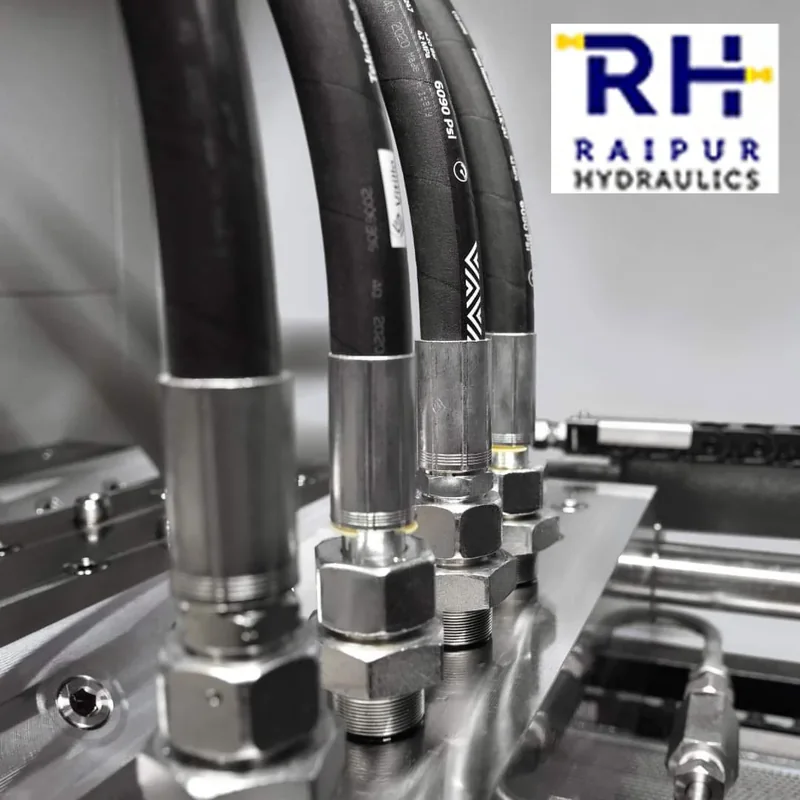
EN 856 identifies spiral-wire hydraulic hose types. The historical EN 856:2015, clause 3 distinction describes 4SP as medium-pressure and 4SH as extra-high-pressure within that family; these are category descriptions, not a universal pressure rating. Both use four steel-wire spiral layers around a synthetic-rubber tube, with a protective rubber cover. Semperit, Version 04-2026, pp. 36–37 documents this construction for the compared products.
Spiral reinforcement differs from an interwoven wire braid. Reinforcement supports pressure loads, while the tube must suit the fluid and the cover must suit the environment. Matching the printed family name alone does not establish compatibility with an old fitting, crimp setting or machine installation.
Typical catalogue ranges overlap rather than match completely. In this Semperit edition, 4SP runs from nominal 3/8 to 2 inches and 4SH from 5/8 to 2 inches (pp. 36–37). Treat these as manufacturer ranges, not guaranteed local stock or the dimensional limits of every EN product.
Same-Size Pressure and Bend-Radius Comparison
Every numeric cell below comes from one source: Semperit Hydraulic Hoses, Version 04-2026, printed pages 36–37. WP means maximum working pressure. ID is the catalogue internal diameter, common to both products at each listed size; the inch column is the nominal size designation, not an exact conversion of that diameter.
| Dash | Nominal Size (in) | Catalogue ID (mm) | 4SP Max WP (bar) | 4SP Min Bend (mm) | 4SH Max WP (bar) | 4SH Min Bend (mm) |
|---|---|---|---|---|---|---|
| -12 | 3/4 | 19.5 | 350 | 300 | 420 | 280 |
| -16 | 1 | 25.9 | 320 | 340 | 380 | 340 |
| -20 | 1-1/4 | 32.5 | 210 | 460 | 350 | 460 |
| -24 | 1-1/2 | 38.7 | 185 | 560 | 290 | 560 |
These are public manufacturer hose values, not RHPL specifications or complete-assembly ratings. They are not presented as the minimum requirements of EN 856. No burst-pressure multiplier has been used. Read the exact product data sheet and approved assembly specification before ordering.
The compared 4SH products have higher working pressures at these sizes, while several minimum bend radii are identical. Therefore “higher pressure” does not automatically mean “needs a larger bend”. Product design matters, and a different catalogue series can produce a different comparison.
Relation to SAE 100R12, 100R13 and 100R15
SAE 100R12, 100R13 and 100R15 are separate hose specifications in the SAE J517 family. They are not alternative spellings for 4SP or 4SH. SAE J517_202007 covers dimensional and performance requirements for hydraulic hose; matching requires the detailed specification, not just reinforcement count.
A manufacturer can list more than one specification for a product, sometimes only at selected sizes. For example, Gates catalogue 50080, Edition 2024, p. 32 lists its EFG4K against SAE 100R12 and limits the accompanying 4SP performance statement to specified sizes. That is a product declaration, not permission to substitute every R12 hose for every 4SP hose.
Also check the standard edition. EN 856:2026, official EVS scope lists 4SP, 4SH, R13 and R15; older editions included R12. Ask for the actual product declaration against the required edition. Neither this comparison nor an older catalogue establishes compliance with a newer standard.
Applications in HEMM, Excavators and Presses
On heavy earthmoving machinery and excavators, evaluate spiral hose for demanding hydraulic power circuits where the equipment specification calls for it. Identify the actual circuit and its duty: attachment movement, travel, swing and auxiliary tools can impose different operating conditions even on the same machine.
For a hydraulic press, examine the pressure cycle, dwell periods, oil temperature and movement between connection points. A hose that fits physically may still be unsuitable for repeated loading or the operating fluid. The machine model and the old hose marking are useful starting evidence, but neither replaces the circuit requirements.
For mining enquiries, send the equipment reference and installation photographs with the hose details. See HEMM hydraulic hose supply for the commercial enquiry route. Site-specific fire resistance, guarding and approval requirements need separate confirmation; a spiral construction label does not satisfy them automatically.
Couplings, Skiving and Crimping
Specify a validated hose-and-coupling system. The insert, ferrule, hose construction, preparation and crimp procedure work together. A fitting that enters the bore or resembles the removed fitting is not enough evidence of suitability.
Skiving removes a controlled portion of cover or tube where the assembly system requires it. Some systems use external skiving, some require additional internal preparation, and others are designed for no-skive assembly. Do not infer the method from “4SP” or “4SH” alone. Use the manufacturer’s current instructions and crimp data for the exact combination; Gates Safe Hydraulics explains matched-system selection and assembly checks.
The assembly rating is constrained by its approved components and service conditions. SAE J517_202007 specifically limits assembly working pressure by the lower applicable hose or connector rating. Pressure testing does not turn an unvalidated component combination into an approved substitute.
Routing and Bend-Radius Considerations
Compare the installed route with the selected product’s minimum bend radius, including movement through the machine’s full working travel. Leave the specified straight section near fittings, prevent twisting, and allow for movement without pulling the hose taut. Avoid contact with sharp edges, hot surfaces and moving parts.
Where space is restricted, review fitting orientation, suitable elbows and clamp positions with the equipment requirements. Do not force a hose into a tighter curve because its pressure rating looks adequate. Gates Safe Hydraulics, installation guidance covers these routing principles. Protection sleeves can address particular external hazards, but they do not correct an unsuitable bend or increase the hose’s pressure rating.
How to Choose and Prepare an Enquiry
- Record the equipment, circuit function and existing hose identification.
- Confirm working pressure, pressure peaks, duty cycle, fluid and service temperature from reliable machine information.
- Specify bore, overall assembly length, end connections and elbow orientation; include photographs or a drawing.
- Check the available route, movement, cover protection and minimum bend radius for the proposed product.
- Request the exact hose series, compatible coupling system, preparation instructions and applicable conformity evidence.
- Have the technical team approve any substitution before the purchase order is released.
Browse hydraulic hoses and hose assemblies, or send an RFQ with the application details. Keep a record of the accepted specification so repeat purchases do not drift into a different construction or coupling system.
Frequently Asked Questions
Is 4SH Always a Better Choice Than 4SP?
No. Higher catalogue pressure alone does not resolve routing, fluid compatibility, coupling selection or equipment approval. Choose the exact product that meets the complete application requirements.
Can I Replace 4SP With 4SH at the Same Bore?
Only after technical verification of the proposed hose, fittings, installation and duty. Equal bore does not establish equivalent external dimensions, assembly preparation or approved performance.
Do All 4SH Hoses Need Skiving?
No universal skive rule follows from the family name. Check the current assembly instructions for the particular hose and coupling system.
Does the Table Give the Pressure of an RHPL Assembly?
No. It reproduces selected public Semperit hose values from the cited catalogue. The complete assembly needs its own confirmed specification.
Are SAE Spiral Hoses Automatically Equivalent to EN Types?
No. Use the manufacturer’s explicit specification and size-specific declarations. Related spiral constructions do not make different standards interchangeable.
What Should I Send for a Replacement Quote?
Send the machine and circuit details, old hose markings, end-fitting photographs, assembly length, orientation and known operating conditions. Identify uncertain information so it can be checked before manufacture.
Technical References
Consult the current product and equipment instructions for the proposed application. The references below support the general technical background; they do not validate an RHPL assembly.
- Semperit Hydraulic Hoses — Version 04-2026, pp. 36–37
- Gates Hydraulic Hose and Couplings — 50080, Edition 2024, p. 32
- SAE J517_202007 — Hydraulic Hose
- EN 856:2026 — Official EVS Scope
- Gates Safe Hydraulics — Selection, Assembly and Installation
- EN 856:2015 — Historical Classification, Clause 3 (p. 5)
Caterpillar, Volvo, Komatsu, Hitachi, Danfoss, Parker, Manuli and Swagelok are trademarks of their respective owners. RHPL is not affiliated with or endorsed by these brand owners. Gates is a trademark of Gates Corporation; RHPL is an Authorised Gates Distributor. Brand and machine names are used only to identify compatibility. External manufacturer references provide general technical background and do not imply endorsement of RHPL products.