Why rock breaker hoses fail early.
Read how vibration, repeated loading and cracked nipples affect rock breaker hoses. RHPL manufactures replacement hydraulic hose assemblies in Raipur. Send your old hose-tag photo or requirement on WhatsApp +91 88717 39555.
The connection deserves as much attention as the hose.
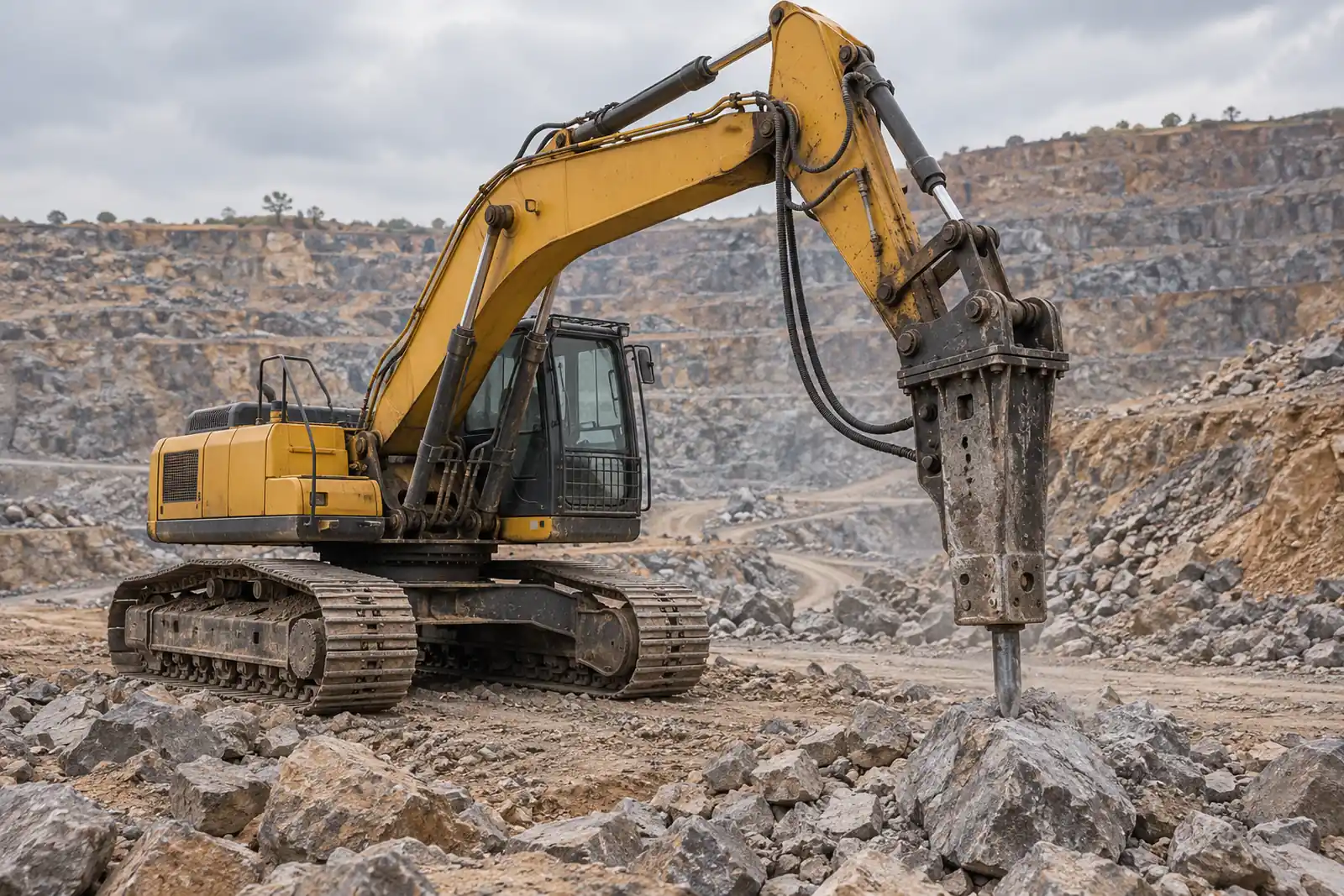
Rock breaker hose assemblies face repeated vibration, pressure changes, movement and external contact. Early failure can occur in the metal nipple as well as the hose body. RHPL focuses on its own heavy-duty nipple design, material selection, in-house high-pressure testing and high-tensile spring protection to address these demanding conditions.
Why do rock breaker hoses fail so quickly?
A hydraulic rock breaker performs repeated impact work. Its connection hoses must carry oil while accommodating movement between the attachment and carrier. Depending on the installation, the assembly may also rub against nearby surfaces or face contact with broken material. A hose selected only by diameter and nominal pressure can overlook these demands.
Several different failures are often described simply as a “pipe problem”. Identifying the failed component is the first step towards a useful replacement.
| Observed symptom | What needs checking |
|---|---|
| Crack in the metal nipple or stem | Repeated bending and vibration, fitting design, material condition and loads imposed by the route. |
| Leak at the machine connection | Connection match, sealing faces, seals and tightening to the applicable instructions; a leak alone does not prove nipple cracking. |
| Leak or movement at the crimp | The specified hose–fitting combination, assembly process and evidence of pulling or movement. |
| Rubbed cover or exposed reinforcement | Contact points, clearance, hose support and external protection. |
| Damaged or burst hose body | Operating conditions, pressure peaks, temperature, fluid compatibility, bend geometry and previous damage. |
Replacing an assembly without investigating the failure can reproduce the same problem. A higher pressure rating alone does not correct a hose that is pulled tight, twisted or repeatedly loading its nipple sideways.
Nipple fatigue: a small component with a major effect
Here, “nipple” means the metal insert or stem of the hose end fitting. In RHPL’s application experience, premature nipple cracking is an important failure mode in rock breaker hose assemblies. The outer rubber may still look serviceable when the connection has already become the weak point.
Repeated loading can initiate and grow fatigue cracks. A hose that bends sharply near its coupling, pulls on the fitting or moves without suitable support can add stress to this region. The breaker’s vibration makes it especially important to consider the end fitting and route together.
A cracked nipple is not the same defect as a loose nut or damaged seal. The failed sample and installation history help establish what happened. Simply tightening a leaking connection is not a repair for cracked metal.
If cracking, leakage, reinforcement exposure or fitting movement is suspected, stop using the affected assembly. Trained personnel should isolate the machine, secure the attachment and release stored energy under the OEM procedure before inspection. Never search for a pressurised leak with your hand.
How RHPL approaches longer, more dependable hose service
RHPL’s premium rock breaker hose assemblies are developed around the connection as well as the hose. Our approach targets premature nipple cracking and external damage, with the aim of improving service life under correctly specified and installed conditions.
Our own heavy-duty nipple design
We use a heavy-duty nipple design developed by RHPL for rock breaker hose applications. The design responds to the repeated loading encountered at the connection. Its detailed geometry remains part of our internal engineering information.
Material selected with cracking resistance in mind
RHPL selects nipple material with resistance to premature cracking as a design objective. A durable connection depends on the material and component design working together; the word “heavy-duty” should not be reduced to appearance or weight alone.
In-house high-pressure testing and internal approval
RHPL has carried out high-pressure testing in-house and approved this design through its own internal process. This is an RHPL design and testing statement, not a claim of independent certification or approval by an equipment manufacturer.
A pressure test checks performance under the conditions of that test. It does not, by itself, establish a guaranteed number of hammering cycles or operating hours in the field. Service life also depends on installation, pressure behaviour, duty and maintenance.
The complete assembly matters
The proposed hose, nipple, ferrule, connection and protection must suit the actual requirement together. Send the breaker and carrier details so the assembly can be reviewed for the application, rather than selecting from appearance alone.
Why RHPL uses high-tensile spring protection
RHPL uses high-tensile spring protection on its rock breaker hose assemblies to help guard the hose exterior against mechanical contact and abrasion. This addresses a different problem from nipple cracking: protecting the flexible hose in a demanding working environment.
The spring does not increase the hydraulic pressure rating, eliminate vibration or make a damaged hose safe. It also cannot correct a tight bend or a strained connection. Protection needs to work with adequate clearance and a route that allows the required movement.
Inspect the protection along with the hose. Displaced or damaged protection and persistent contact marks are reasons to review the installation, not simply cover the area again.
Before fitting the next replacement
- Identify what failed. Preserve photographs and, where practical, the safely removed sample. Record whether the damage is in the nipple, seal, crimp or hose body.
- Check the full movement envelope. The hose must not become taut, twist, rub or bend tighter than its permitted radius as the attachment moves.
- Review the machine conditions. Have a qualified technician check breaker supply, return conditions and any suspected abnormal pressure behaviour against the applicable OEM instructions.
- Confirm the end connections. Thread engagement alone does not prove that the sealing form and mating fitting are correct.
- Record the outcome. Note installation date, operating hours, working conditions and the reason for removal. This makes service-life comparisons meaningful.
Use our hose assembly measurement guide when preparing a replacement enquiry, and our fitting identification guide when the end connection is uncertain.
Discuss your rock breaker hose requirement with RHPL
Send the breaker make and model, carrier machine details, hose reference if available, required quantity and delivery location. Clear photographs of both ends, the installed route and the failed area help us review repeat failures. Share dimensional and operating details privately with your enquiry; a sample or approved drawing may be needed.
Repeated nipple cracks or short hose life?
Ask RHPL to review your requirement for a premium rock breaker hose assembly with our heavy-duty nipple design and spring protection.
Request a rock breaker hose quotationDiscuss on WhatsAppExplore rock breaker applicationsFrequently asked questions
Why does a rock breaker hose nipple crack while the hose looks sound?
The metal stem and flexible hose experience different stresses. Repeated vibration, bending or pulling at the connection can contribute to fatigue cracking in the stem even when the outer hose cover looks intact. Inspection is needed to distinguish a cracked stem from a seal leak, loose connection or crimp problem.
Will a higher-pressure hose alone solve repeated breaker hose failures?
Not necessarily. If the failure is in the nipple or is caused by routing, twist or external damage, changing only the hose pressure rating may leave the cause in place. The complete assembly and its installation need review.
What makes RHPL rock breaker hose assemblies different?
RHPL uses its own heavy-duty nipple design, material selected with resistance to premature cracking in mind, in-house high-pressure testing and internal design approval. High-tensile spring protection adds an external protective layer. These choices are intended to support dependable service in demanding breaker applications.
Does a protective spring prevent nipple cracking?
A spring primarily helps protect the outside of the hose from mechanical contact and abrasion. It does not eliminate vibration or pressure pulses, and cannot compensate for a strained fitting, wrong routing or unsuitable assembly.
How much longer will an RHPL breaker hose last?
There is no single service-life figure for every breaker. Life depends on duty, pressure pulses, routing, operating conditions and maintenance. RHPL’s design aims to address premature nipple cracking and external damage; a fixed life multiplier or guaranteed number of operating hours is not stated here.
Does internal approval mean approval by the breaker manufacturer?
No. RHPL’s in-house high-pressure testing and internal design approval are RHPL processes. They do not imply independent certification or endorsement by the excavator, breaker or hose-component manufacturer.
Technical background and RHPL experience
The RHPL design, material-selection, spring and internal-testing statements above describe RHPL’s own product approach. General hose-system guidance can be found in the manufacturer references below. These references do not validate or endorse an RHPL assembly.
- Gates — Introduction to Hydraulic Hose and Fittings 201
Background on hose assemblies, routing and connection problems. Use current, application-specific instructions for selection and installation.
- Gates — Coming Together: Hose-Coupling Interfaces
Why the hose–coupling interface and controlled assembly process matter.
- Epiroc — Connection hoses for concrete busters
An adjacent demolition-attachment example of steel-spiral protection against external mechanical damage; not a rock breaker selection specification.